


The information in this article is for educational and informational purposes only. It is not intended as veterinary advice, diagnosis, or treatment for any medical or health issue your pet may have.
Always consult a licensed veterinarian before making any decisions about your pet’s health, diet, medications, supplements, training, or care. Never disregard or delay professional veterinary advice based on content from this website.
BarkleyAndPaws.com and its authors assume no responsibility or liability for any errors, omissions, or outcomes resulting from the use of this information.
A cat who knocks a glass off the nightstand at 3 a.m. is not always being mischievous. Sometimes they are just under-stimulated, wide awake, and looking for something – anything – to do. That is why indoor cat enrichment ideas matter so much, especially for cats who spend all or most of their time inside.
Indoor living can be safer for cats, but safe does not automatically mean satisfying. According to the ASPCA, enrichment helps support an animal’s physical and mental well-being by encouraging natural behaviors like hunting, climbing, scratching, and exploring. For indoor cats, the goal is not to turn your living room into a jungle. It is to make everyday life more interesting, more active, and less predictable in the right ways.
Why indoor cats need enrichment
Cats are built to stalk, pounce, patrol territory, and make choices throughout the day. When the environment stays flat and repetitive, some cats respond with overeating, overgrooming, nighttime restlessness, or attention-seeking behaviors. Others simply sleep more than they should and become less physically fit over time.
The American Association of Feline Practitioners has long emphasized that cats need an environment that supports key behavioral needs, including opportunities to play, scratch, perch, and retreat. Meeting those needs can reduce stress and make behavior problems easier to prevent, not just manage.
That does not mean every cat needs the same setup. A bold young cat may want fast-paced play and climbing routes across the house. A shy senior may benefit more from cozy window access, easier ramps, and low-impact puzzle feeding. Good enrichment is not about doing everything. It is about matching the activity to the cat in front of you.
Indoor cat enrichment ideas for daily life
The best indoor cat enrichment ideas are usually the ones you can repeat without turning them into a major project. A few thoughtful changes often work better than a pile of ignored toys.
Make mealtime feel like a hunt
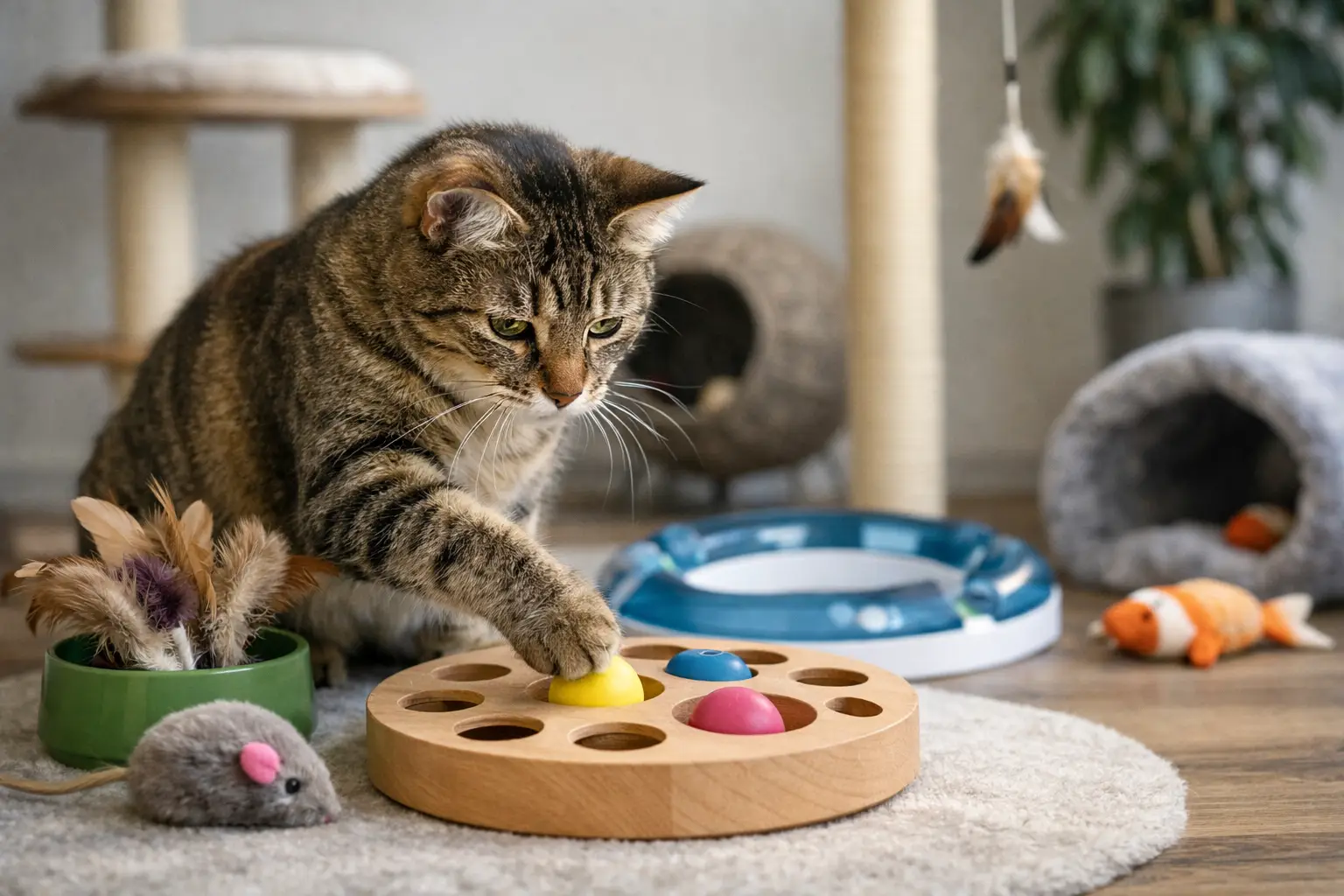
If your cat finishes a bowl in 30 seconds and then looks bored, start with food. Puzzle feeders, treat balls, and simple food hunts encourage cats to work for part of their meals. This taps into natural foraging behavior and slows down fast eaters.
You do not need expensive gear to get started. Hide a few pieces of kibble in safe spots, place treats in a cardboard egg carton, or use a beginner puzzle feeder. If your cat gets frustrated easily, keep the challenge simple at first. The point is engagement, not a test.

Rotate toys instead of leaving everything out
A toy mountain on the floor can become invisible surprisingly fast. Cats often respond better when a few toys are available and others are stored away for later rotation. Bringing back a wand toy after a week can make it feel new again.
Try offering different prey styles. Some cats love feather chasers, while others prefer small mice they can carry or kick toys stuffed with catnip or silvervine. Variety matters because play preferences vary just as much as personalities do.
Build vertical space
Many indoor cats feel better when they can go up. Cat trees, wall shelves, sturdy bookcases with safe landing spots, and window perches all expand territory without adding square footage. Vertical space can be especially helpful in multi-cat homes, where sharing floor space may create tension.
The Ohio State University Indoor Pet Initiative notes that cats benefit from being able to perch, climb, hide, and observe from a distance. A tall perch near a calm part of the home can become a cat’s favorite place for both rest and surveillance.
Create a better window experience
A plain window can become cat TV with a few adjustments. Add a stable perch, open the blinds safely, and place a bird feeder outside if your setup allows it and local wildlife can be supported responsibly. Watching movement outdoors gives many cats a form of low-effort mental stimulation.
If your cat becomes frustrated by outdoor animals they cannot reach, monitor their reaction. For some cats, window watching is relaxing. For others, especially highly aroused or territorial cats, it can increase agitation.
Play that actually satisfies your cat
A lot of owners think their cat does not like play when the real issue is the style of play. Waving a toy in their face usually does not mimic prey. Small movements, pauses, hiding behind furniture, and letting the cat stalk before they pounce tend to work much better.
Use interactive play in short sessions
Two or three 10-minute sessions a day can make a real difference. Wand toys are especially useful because they let you imitate prey movement while keeping hands safely out of range. Let the toy skitter, hide, dart, and pause. End with a catch so the sequence feels complete.
This matters because cats are not just chasing movement. They are following a hunt cycle. According to International Cat Care, play is most effective when it allows stalking, chasing, pouncing, and grabbing rather than endless, frustrating pursuit.
Give kickers and solo toys a job
Not every cat wants human-led play every time. Kicker toys, ball tracks, crinkle tunnels, and lightweight toss toys can help during solo hours. Battery-operated motion toys can be useful too, but they tend to work best as part of a mix, not the entire plan. Some cats love them. Others lose interest once the pattern becomes predictable.
Don’t forget scratching stations
Scratching is not bad behavior. It is a normal behavior that maintains claws, stretches the body, and leaves visual and scent marks. Offering multiple scratching surfaces in different textures – sisal, cardboard, carpet-style if safe for your household – gives your cat an acceptable outlet.
Placement matters more than many people realize. Put scratchers near sleeping areas, entry points, and spots where your cat already tries to scratch. A perfect scratching post hidden in the laundry room is still the wrong scratching post.
Enrichment for shy, senior, or high-energy cats
Not all enrichment needs to be exciting. Sometimes the best setup lowers stress instead of increasing stimulation.
Shy cats often do better with hideouts, covered beds, predictable routines, and interactive play that keeps more distance between cat and person. Senior cats may still enjoy enrichment, but they may need lower platforms, softer landings, and puzzles that do not require athletic effort. High-energy young adults usually need the opposite – more frequent play, more climbing options, and more problem-solving around food.
If your cat has sudden behavior changes, reduced mobility, or seems withdrawn, do not assume boredom is the only issue. Pain, illness, and cognitive changes can all affect activity and behavior. The AVMA advises pet owners to watch for shifts in routine, appetite, grooming, and social behavior, all of which can signal a medical concern.
A few mistakes to avoid with indoor cat enrichment ideas
More stimulation is not always better. A nervous cat may feel overwhelmed by constant novelty, loud toys, or being pushed into interaction. Start small and observe what your cat actually uses.
It also helps to avoid relying on catnip for every cat. Some love it, some do not respond, and some become too aroused. Silvervine is a useful alternative for certain cats, but even then, moderation is smart.
Finally, keep safety in the foreground. Strings, ribbons, hair ties, rubber bands, and toys with loose parts can become hazards quickly. Supervised play is best for anything that could be swallowed or torn apart.
How to keep enrichment realistic
The best plan is one you will continue. That might mean a morning puzzle feeder, an evening wand session, a cat tree by the window, and a scratcher in the hallway. It does not need to be elaborate to be effective.
If you want to refresh your setup over time, pay attention to what your cat repeats. Do they choose height or hiding? Chasing or batting? Quiet observation or full-speed sprints? Those patterns tell you more than any product label ever will. If you want more practical pet care ideas like this, Barkley and Paws covers everyday ways to support a healthier home life for cats and dogs alike.
A well-enriched indoor cat is not just busier. They are often more settled, more confident, and easier to live with – which makes home feel better for both of you.