


The information in this article is for educational and informational purposes only. It is not intended as veterinary advice, diagnosis, or treatment for any medical or health issue your pet may have.
Always consult a licensed veterinarian before making any decisions about your pet’s health, diet, medications, supplements, training, or care. Never disregard or delay professional veterinary advice based on content from this website.
BarkleyAndPaws.com and its authors assume no responsibility or liability for any errors, omissions, or outcomes resulting from the use of this information.
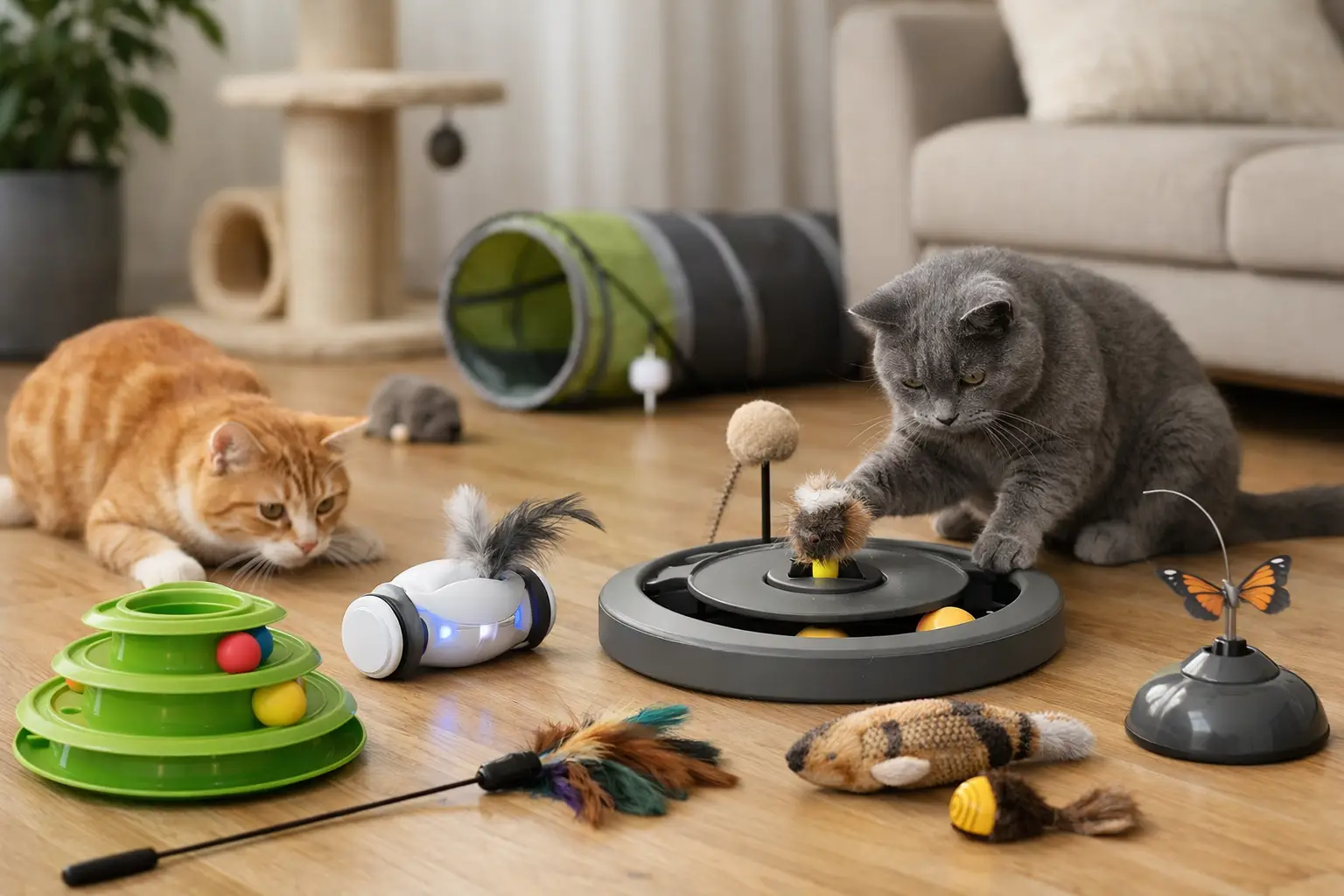
If your cat is knocking pens off the counter at 3 a.m., sprinting down the hallway for no obvious reason, or staring at you like you personally ruined their evening, boredom may be part of the problem. The best toys for bored cats do more than keep them busy for ten minutes – they tap into stalking, chasing, climbing, scratching, and problem-solving instincts that indoor cats still carry every day.
A bored cat is not necessarily a badly behaved cat. Often, it is a cat with energy, curiosity, and very few satisfying ways to use either. That matters because enrichment is tied to overall welfare. Cats need chances to hunt, explore, and interact with their environment, not just a food bowl and a sunny window.
What makes the best toys for bored cats work?
The toys that actually hold a cat’s attention usually mimic prey or create a small challenge. Fast, unpredictable movement works well for many cats because it feels like chasing something alive. Food puzzles appeal to cats that are highly motivated by treats. Tunnel toys, kickers, and climbing add another layer by letting a cat hide, pounce, bunny-kick, or patrol territory.
The catch is that there is no single toy every cat will love. A young, athletic cat may obsess over a wand teaser and ignore a puzzle feeder. A senior cat with arthritis may prefer slow-moving toys, soft kickers, or lick mats over leaping games. Personality matters as much as age.
12 best toys for bored cats
1. Wand teaser toys
If you only buy one interactive toy, make it a wand. A good wand toy lets you mimic prey in a way that feels natural to your cat – skittering behind furniture, pausing under a rug edge, then darting away. That kind of movement is far more engaging than simply dangling a feather in the air.
These toys are best for cats that crave attention and active play. They do require your time, but they also tend to deliver the biggest payoff in exercise and bonding. The main trade-off is durability. Many cats shred feather attachments quickly, so replace worn pieces before your cat can swallow them.
2. Puzzle feeders and treat toys
Some bored cats are really under-challenged cats. Puzzle feeders make meals and treats something to work for, which slows eating and adds mental stimulation at the same time. For food-driven cats, this can be one of the most effective boredom busters in the house.
Start easy. If the puzzle is too frustrating, your cat may walk away. Once they understand the game, you can rotate in harder options. This category is especially useful for cats that seem restless between meals or beg constantly.
3. Cat tunnels
A tunnel looks simple, but it checks several boxes at once. It gives a cat a hiding place, an ambush spot, a path to charge through, and a crinkly object to investigate. Pair a tunnel with a tossed toy mouse or wand game, and the tunnel often becomes the star of the show.
This is a strong pick for multi-cat homes too, since cats can chase each other through it or use it as a retreat. If your cat is sound-sensitive, skip the loudest crinkly versions and choose a softer fabric style.
4. Ball tracks and rolling toys
For cats that like batting and repeated motion, a track toy with enclosed balls can keep the paws busy without making a mess under the couch. These toys are practical for solo play and usually hold up well over time.
They are not thrilling for every cat, though. Some cats love the repetitive movement, while others lose interest after a few sessions. Rotating them out and bringing them back later often helps.
5. Kick toys filled with catnip or silvervine
Kick toys are ideal for cats that grab prey with their front paws and bunny-kick with the back legs. That behavior is normal predatory play, and a long plush kicker gives them a safe, satisfying outlet.
Catnip can make these toys more appealing, but not every cat responds to it. Silvervine is another option that some cats find even more exciting. If your cat gets overstimulated easily, offer kicker toys in short sessions rather than leaving several out all day.
6. Battery-powered moving toys
Motorized toys can be helpful when your cat wants action and you are on a work call. The better ones move unpredictably, pause and restart, or hide under fabric in a prey-like way. For some cats, that random movement is irresistible.
This is where trade-offs matter most. Great motorized toys can be expensive, batteries add up, and some models are noisy enough to scare timid cats. Supervision is smart at first, especially if the toy has strings, small parts, or a powerful spinning mechanism.
7. Laser pointers
Laser pointers can absolutely get a cat moving, especially in small indoor spaces where there is not much else to chase. They are handy for quick bursts of exercise and can encourage less active cats to move more.
But they should not be your only play tool. Because there is nothing physical to catch, some cats end a laser session feeling frustrated. A better approach is to finish by directing the laser onto a real toy or treat so your cat gets a satisfying “capture.”
8. Toy mice and plush prey
There is a reason these classics stick around. Small mice, birds, and plush prey toys are easy to bat, carry, and stash in secret locations around the house. They work best for cats that prefer short, independent play sessions throughout the day.
Look at size and material. A toy that is too small can become a choking risk, while one that is too large may not feel satisfying to carry. Soft fabric toys with a little texture often get more attention than slick plastic ones.
9. Scratching posts with built-in play features
A scratcher that also includes a perch, hanging toy, or track can do more than save your sofa. It gives your cat a place to stretch, mark territory, and pause for play in the same spot. For bored cats, that combination can increase how often they engage with the environment on their own.
Vertical scratchers are great for cats that like a full-body stretch. Horizontal cardboard scratchers can be better for cats that prefer to crouch and rake. If your cat ignores one style, the issue may be the format rather than the idea.
10. Window perches and bird-view toys
Not every toy needs to be batted or chased. For many indoor cats, a window perch overlooking birds, squirrels, or neighborhood activity functions like live entertainment. Add a suction-cup bird toy or rustling hanging toy nearby, and the area becomes a stimulation zone.
This is a particularly good choice for cats left alone for part of the day. The downside is simple: if the view is boring, the perch may be too. Placement matters more than price here.
11. Cat springs
Plastic cat springs are cheap, lightweight, and weirdly effective. They bounce unpredictably, skitter across hard floors, and are easy for a cat to carry in their mouth. Plenty of owners buy expensive toys only to discover their cat would rather chase a spring into the laundry room.
The obvious drawback is that they disappear under appliances at an impressive rate. Keep a stash on hand if your cat falls in love with them.
12. Rotating toy boxes
This is less a single toy than a strategy, but it belongs on the list because novelty matters. If every toy is available all the time, many cats stop noticing them. A toy rotation system keeps interest higher by limiting what is out and changing it every few days.
You do not need a huge collection. A small mix of chase toys, chewable or kickable toys, and one food puzzle often goes further than a giant basket dumped in the corner.
How to choose the best toys for bored cats by personality
Think first about how your cat already plays. If they crouch behind furniture and ambush your ankles, prey-like toys and tunnels will usually beat stationary toys. If they wake you up for breakfast two hours early, puzzle feeders may solve more than boredom. If they stare out the window all afternoon, climbing options and observation spots may matter as much as toys.
Age and health matter too. Kittens and young adults usually need more movement and more frequent play. Senior cats still need enrichment, but they often prefer shorter sessions and lower-impact toys. If your cat has mobility issues, choose toys that can be batted from a seated or lying position.
Safety matters more than novelty
The most exciting toy is a bad buy if it can be swallowed, splintered, or tangled around your cat. Loose feathers, ribbons, elastic strings, button batteries, and tiny detachable parts deserve extra caution. Supervise interactive string toys and put them away when playtime ends.
It is also smart to inspect toys regularly. Frayed fabric, exposed stuffing, cracked plastic, and broken seams can turn a favorite toy into a hazard quickly. If your cat chews aggressively, durability should be high on your priority list.
The toy is only part of the fix
Even the best toy will not fully solve boredom if your cat’s routine is flat. Most cats do better with short, predictable play sessions once or twice a day, especially before meals. That pattern mimics hunt-catch-eat behavior and can help with restlessness later on.
Environmental enrichment matters just as much. A climbing tree, cardboard box, open window view, hiding spots, and opportunities to explore different heights often make toys more effective because the whole space feels more interesting.
If your cat suddenly seems more destructive, vocal, or withdrawn, do not assume boredom is the whole story. Behavior changes can also point to stress or medical issues, so a veterinary check is worth considering if something feels off.
A bored cat is really asking for a better outlet. When you match the toy to the cat instead of buying whatever looks cutest on the shelf, playtime gets easier, your home gets calmer, and your cat gets to act a little more like a cat.