


The information in this article is for educational and informational purposes only. It is not intended as veterinary advice, diagnosis, or treatment for any medical or health issue your pet may have.
Always consult a licensed veterinarian before making any decisions about your pet’s health, diet, medications, supplements, training, or care. Never disregard or delay professional veterinary advice based on content from this website.
BarkleyAndPaws.com and its authors assume no responsibility or liability for any errors, omissions, or outcomes resulting from the use of this information.
The first face-to-face meeting between two cats can go sideways fast. A hard stare, a puffed tail, one badly timed hiss, and suddenly you are wondering whether you made a huge mistake. The good news is that learning how to introduce cats safely is less about luck and more about pacing, setup, and reading what each cat is telling you.
Most cats do not want to become instant roommates. They are territorial, sensitive to change, and highly tuned in to scent. That is why the best introductions begin before the cats ever share a room. According to the ASPCA, gradual introductions help reduce stress and lower the chance of fear-based aggression. ASPCA guidance on cat aggression supports taking things step by step rather than forcing contact.
Why introducing cats safely takes time
Cats are not being difficult when they growl under a door or swat during an early meeting. From their perspective, a stranger has appeared in their territory, carrying unfamiliar smells and unpredictable energy. Some cats adapt in days. Others need weeks. A few need much longer, especially if they are older, easily stressed, poorly socialized, or have a history of conflict with other pets.
That is the trade-off many owners miss. Moving too slowly can feel frustrating, but moving too fast often creates setbacks that take longer to undo. If one cat becomes frightened or starts guarding space, litter boxes, or food, you are no longer just doing an introduction. You are managing a conflict.
Before you begin, it helps to make sure both cats are healthy. Pain and illness can make tolerance much lower. The American Veterinary Medical Association emphasizes routine veterinary care as part of responsible pet ownership, and that matters here more than people think. AVMA cat care resources can help owners think through the basics before a major household change.

How to introduce cats safely: start with separation
Set up the new cat in a separate room with food, water, a litter box, bedding, scratching options, and a place to hide. This is not a punishment. It is a decompression zone. Your resident cat keeps normal access to the home, while the newcomer gets a manageable space to settle into.
During this stage, the goal is not friendship. It is familiarity without pressure. Each cat learns that the other exists, but nothing bad happens because of it.
Scent is your biggest tool. Swap bedding between the cats. Gently rub a soft cloth on one cat’s cheeks and place it near the other’s resting area. Feed treats or meals near opposite sides of the closed door so they begin to associate the other cat’s smell with something positive.
If either cat stops eating, hides constantly, or fixates at the door with intense vocalizing, slow down. Curiosity is workable. Obsession is a sign that stress may be rising too fast.
Watch behavior, not the calendar
There is no perfect day to move to the next step. Some cats are ready for visual contact after two or three days. Others need a week or more. What matters is whether both cats can stay relatively calm around the closed door.
Signs you can progress include eating near the door, relaxed body posture, brief interest without prolonged stalking, and the ability to walk away. Signs you should wait include lunging, growling, spraying, crouching with a fixed stare, or refusing food near the door.
Controlled visual contact comes next
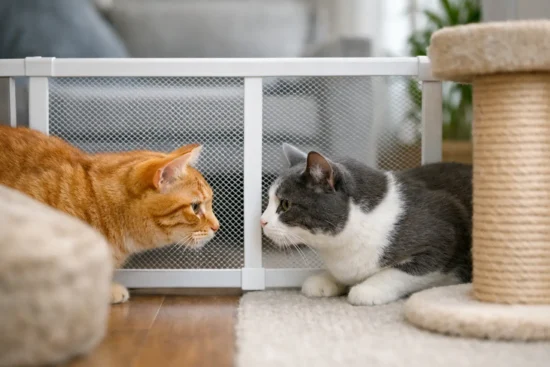
Once both cats seem calmer with scent and sound, allow limited visual access. A cracked door, baby gate with coverage, or screen barrier can work, though setup depends on your home and how athletic your cats are. The barrier matters because it prevents chasing and swatting while letting them see each other.
Keep these sessions short and positive. Offer treats, wet food, or play on each side of the barrier. End before either cat gets overstimulated. You want repeated exposures that feel boring in the best possible way.
This is where many owners accidentally sabotage progress. They see one calm minute and decide the cats are ready to work it out on their own. Usually, they are not. Calm, repeatable sessions beat one dramatic leap every time.
The first in-room meeting
When both cats can see each other without escalating, try a short supervised meeting in a shared space. Choose a room with multiple exit paths and vertical options like a cat tree, sturdy shelf, or window perch. Never place them together in a small space where one cat can corner the other.
Keep the session brief. A few minutes may be plenty. Distract lightly with treats or wand toys, but do not force interaction. If they want to observe from opposite ends of the room, that is fine. Neutral is a win.
A little tension does not always mean failure. Some hissing is normal communication. A low growl can mean, give me space. What you do not want is hard staring, stalking, ears flattened sideways or back, puffed fur, repeated charging, or a chase. Those behaviors tell you the cats are no longer processing the meeting calmly.
If things get tense, do not grab either cat with your hands. Redirect with a large pillow, piece of cardboard, or blanket between them, then separate and reset. PetMD notes that punishment and forced confrontation can increase fear and aggression in cats. PetMD on cat aggression toward other cats reinforces the value of management and gradual exposure.
Set up the home so neither cat has to compete
Even cats that tolerate each other may struggle if the environment creates competition. One litter box in a hallway corner is not enough for a multi-cat household. Neither is a single feeding station if one cat is pushy.
As a rule, offer multiple key resources in separate areas. That means litter boxes, water, resting spots, scratching posts, and elevated spaces. Spread them out so one cat cannot block access to everything at once.
This part matters just as much as the introduction itself. Some cats seem fine during meetings but start having issues later because they feel crowded or ambushed in daily life. Resource guarding can look subtle at first. One cat simply sits in a doorway. The other stops using a room. Then you find urine outside the litter box and wonder what changed.
Give the resident cat some protection from disruption
Owners naturally focus on helping the new cat adjust, but the resident cat needs stability too. Keep routines as consistent as possible. Feed at normal times. Preserve favorite rest areas. Continue one-on-one attention.
That balance can be tricky in family homes, especially if kids are excited about the new arrival. It helps to explain that a quiet, slower start is the kindest route. Cats rarely appreciate a welcome committee.
When introductions stall
Some pairings are easy. Others are a project. Age, personality, energy level, and prior social experience all shape the outcome. A playful young cat may overwhelm a calm senior. A confident resident cat may react poorly to another cat who stares too much or rushes every interaction.
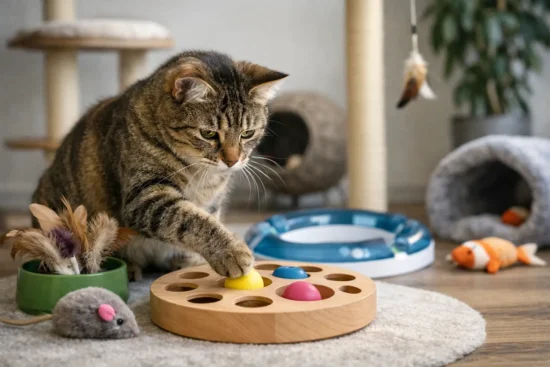
If progress stalls, go back a step. More scent swapping, more barrier sessions, shorter meetings. You can also support the process with environmental enrichment like puzzle feeders, extra climbing space, and daily play to reduce tension.
In some homes, synthetic calming pheromone diffusers can help take the edge off, especially when stress is mild to moderate. They are not magic, but they can be useful alongside behavior management. If one or both cats show intense aggression, chronic spraying, appetite changes, or stress-related overgrooming, talk with your veterinarian. Medical issues, anxiety, and pain can all make introductions much harder.
How to know the introduction is working
Success does not have to mean cuddling in a sunbeam. For many cats, peaceful coexistence is the real goal. They may share space, pass each other without drama, nap in the same room, or engage in brief play without tension. That is a very good outcome.
Some cats do become close companions. Others keep a respectful distance forever. Both are normal. The mistake is measuring success by affection alone instead of safety and reduced stress.
If you are working through how to introduce cats safely, patience is not the boring part of the process. It is the strategy. A slower start gives both cats a fair chance to feel secure, and secure cats make better housemates.