

The information in this article is for educational and informational purposes only. It is not intended as veterinary advice, diagnosis, or treatment for any medical or health issue your pet may have.
Always consult a licensed veterinarian before making any decisions about your pet’s health, diet, medications, supplements, training, or care. Never disregard or delay professional veterinary advice based on content from this website.
BarkleyAndPaws.com and its authors assume no responsibility or liability for any errors, omissions, or outcomes resulting from the use of this information.
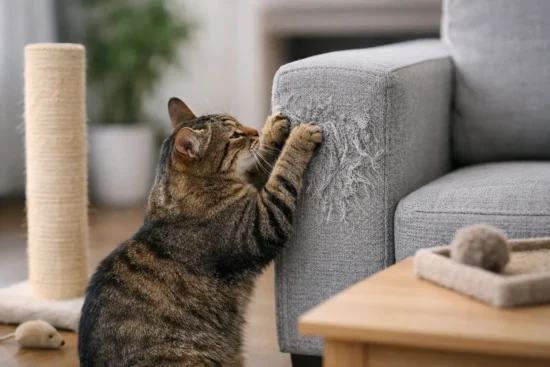
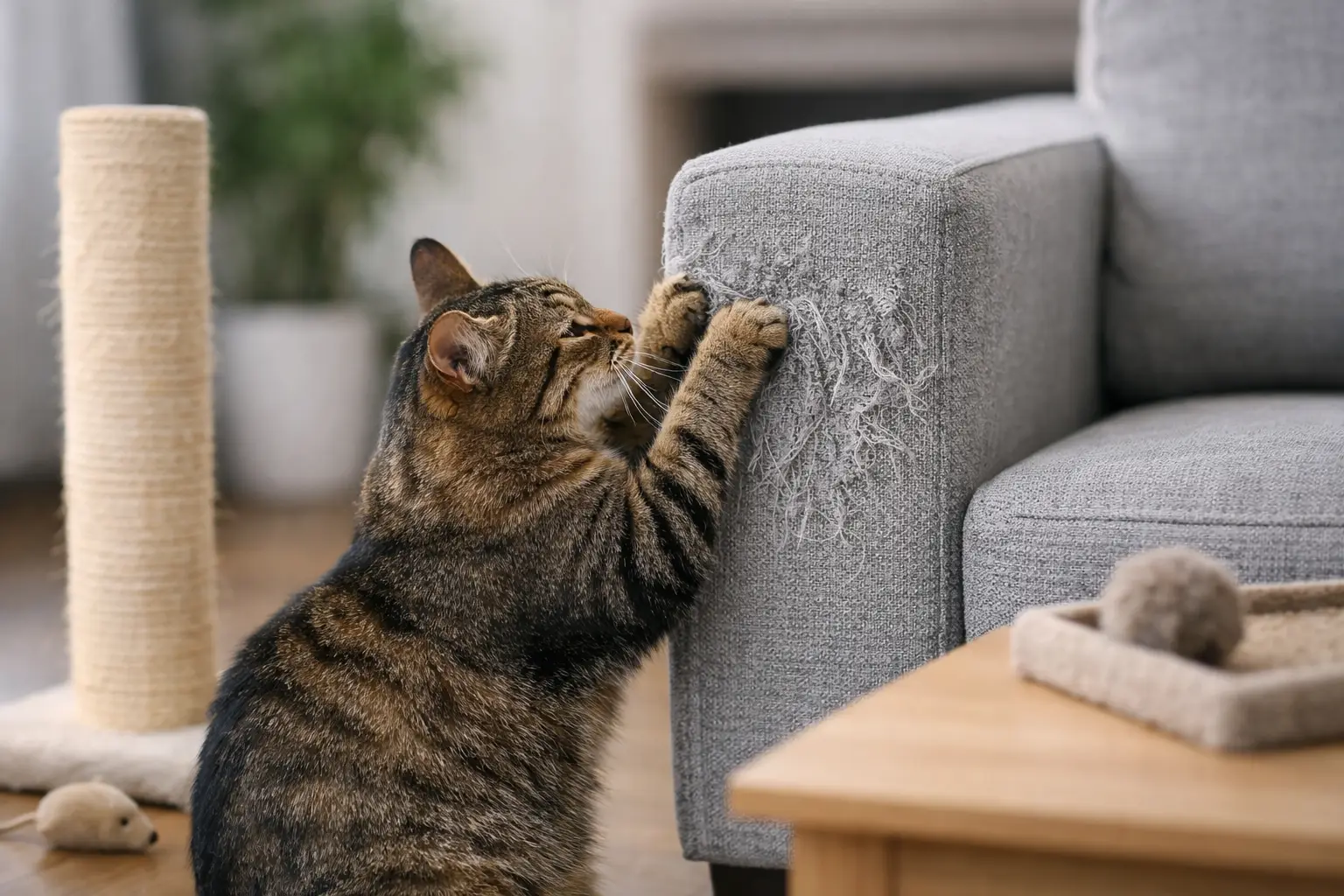
Your cat is not trying to ruin your sofa. They are doing something completely normal, and that detail matters if you want real results. If you are wondering how to stop cat scratching furniture, the goal is not to punish scratching. It is to redirect it to places and surfaces your cat actually wants to use.
That shift in mindset is where most success starts. Cats scratch to stretch, mark territory, shed the outer layer of their claws, and relieve stress or excitement. According to the ASPCA, scratching is a natural feline behavior, which is why yelling or spraying your cat usually makes the problem worse instead of fixing it. A stressed cat often scratches more, not less.
Why cats choose your furniture
Furniture wins for a reason. Upholstered couches, chair arms, rugs, and wood table legs often have the exact texture and stability cats like best. A scratching post that wobbles, feels too short, or sits in a random corner usually cannot compete.
Location also plays a big role. Cats often scratch where they spend time, where they wake up, or where they want to leave a visual and scent mark. That is why the end of the couch near a favorite nap spot gets hit harder than the brand-new scratching post tucked away in the laundry room.
If your cat scratches mostly during changes in the home, stress may be part of the picture too. New pets, visitors, moving furniture, or even boredom can increase scratching. The American Association of Feline Practitioners notes that behavior problems often improve when the cat’s environment is set up to meet natural needs, not just restricted.

How to stop cat scratching furniture without punishment
The fastest way to stall your progress is to make the furniture the center of the battle. Instead, make the right scratching area easier, more rewarding, and better placed than the couch.
Start by putting scratching options directly next to the damaged furniture. This feels backward to some owners, but it works because you are meeting the cat where the behavior already happens. Once your cat consistently uses the post or pad, you can slowly move it a little farther away if needed.
Choose sturdy scratchers with the right shape. Many cats prefer vertical posts tall enough for a full-body stretch. Others love horizontal cardboard loungers or angled scratchers. It depends on the cat. If your cat attacks carpet, a flat or angled scratcher may work better than a tall sisal post. If they target sofa corners, a tall, solid post is often the stronger bet.
Make the approved option more attractive. Sprinkle catnip if your cat responds to it, add toys nearby, or reward your cat with praise and treats when they use it. The Humane Society recommends positive reinforcement for behavior changes because it helps your cat repeat the right choice without adding fear.
Make the furniture less appealing
You do not have to rely on training alone. Management helps a lot, especially in the first few weeks.
Cover the favorite scratching zones with something your cat dislikes, such as double-sided pet tape, a furniture protector, or a tightly tucked throw. Some cats avoid slick or sticky-feeling surfaces. If one texture does not bother your cat, try another. This is one of those areas where it depends on the individual cat.
You can also block access temporarily if the damage is concentrated in one spot. A side table, storage basket, or repositioned chair can interrupt the habit long enough for a new routine to form. The point is not to turn your home into an obstacle course forever. It is to help your cat practice the behavior you want instead.
Avoid punishing your cat when you catch them scratching. Clapping, yelling, or squirting water may stop the moment, but it rarely teaches a better alternative. It can also make your cat wary of you or more likely to scratch when you are not around.
The best scratching setup for most cats
If you are trying to figure out how to stop cat scratching furniture, one post is usually not enough. Most cats do better with several scratching areas placed throughout the home.
A good baseline is one scratching option in each main room your cat uses, especially near sleeping areas, windows, and favorite hangouts. Put one next to the couch if that is the trouble zone. Place another near the bed if your cat scratches after waking up. Add one by a window if your cat gets excited watching birds or neighborhood activity.
Texture matters as much as placement. Sisal rope or sisal fabric works well for many cats, while others strongly prefer cardboard, carpet-like material, or bare wood. If your current post is being ignored, the issue may not be your cat’s stubbornness. It may just be the wrong feel.
Height and stability are non-negotiable. A post should not tip or slide when your cat leans in. For vertical scratchers, taller is usually better. For larger cats, this becomes even more important.
Should you trim your cat’s nails?
Regular nail trims can reduce the amount of damage, but they do not solve the behavior on their own. Think of trimming as part of the plan, not the whole plan. Shorter nails mean less shredding, and many owners find this makes the training phase much easier.
If your cat is not used to nail trims, go slowly. Handle the paws during calm moments, reward generously, and trim just one or two nails at a time if needed. If you are unsure how to do it safely, ask your veterinarian or groomer for a demonstration.
What about nail caps?
Soft nail caps can be helpful for some households, especially while you are retraining a persistent scratcher. They are not the right fit for every cat, and they require upkeep, but they can reduce damage without taking away the urge to scratch. Your cat will still need proper scratching outlets.
Declawing is not a recommended solution. The AVMA explains that declawing is an amputation procedure with welfare concerns and should not be treated as a routine fix for scratching behavior. For most cats, environmental changes and training are safer and more humane approaches.
When scratching is stress-related
Sometimes furniture scratching is less about claws and more about emotions. If the behavior suddenly increases, especially after a move, a new baby, another pet, or schedule changes, your cat may be using scratching as a coping tool.
In that case, look beyond the couch. Does your cat have safe resting areas, vertical space, daily play, and predictable routines? Are there enough litter boxes, food stations, and quiet zones in a multi-cat home? Tension between cats often shows up in subtle ways, and scratching can be one of them.
Interactive play helps more than many owners expect. A cat with pent-up energy is more likely to engage in nuisance behavior. Short daily sessions with a wand toy followed by a meal or treat can lower stress and give your cat a more appropriate outlet.
If your cat also shows hiding, aggression, overgrooming, appetite changes, or litter box problems, talk with your veterinarian. Sudden behavior changes can sometimes point to pain, anxiety, or medical issues.
Common mistakes that keep the problem going
One of the biggest mistakes is buying a single scratching post and assuming the cat will just figure it out. Cats are selective. If the post is too short, wobbly, or poorly placed, it will fail even if it looked great in the store.
Another mistake is moving the scratcher too soon. If your cat has finally started using it beside the couch, leave it there for a while. Convenience is part of why the plan is working.
Owners also sometimes reward the wrong moment without realizing it. If you call your cat over with a treat right after they scratch the sofa, you may accidentally reinforce the whole sequence. Try to reward when your cat uses the approved scratcher, not simply when they stop doing the unwanted behavior.
A realistic timeline for results
Some cats switch to a new scratching setup within days. Others need a few weeks of consistent redirection, better placement, and management. Older habits take longer to break, especially if your cat has been using the same sofa corner for years.
The good news is that this problem is usually very fixable when you stop treating scratching as defiance and start treating it as a need. At Barkley and Paws, we see this pattern again and again with cat behavior issues: progress comes faster when the home setup changes along with the training.
If your couch has become your cat’s favorite scratching station, do not focus on winning that standoff. Give your cat a better option, place it where it counts, and make using it feel easy and rewarding. That is often the moment the whole household gets a little more peaceful.