

The information in this article is for educational and informational purposes only. It is not intended as veterinary advice, diagnosis, or treatment for any medical or health issue your pet may have.
Always consult a licensed veterinarian before making any decisions about your pet’s health, diet, medications, supplements, training, or care. Never disregard or delay professional veterinary advice based on content from this website.
BarkleyAndPaws.com and its authors assume no responsibility or liability for any errors, omissions, or outcomes resulting from the use of this information.
That first walk with a puppy often looks nothing like the picture in your head. Instead of trotting happily beside you, your pup may plant their feet, chew the leash, zigzag across the sidewalk, or flop over like the harness is a personal insult. If you are wondering how to leash train a puppy without turning every outing into a tug-of-war, the good news is that this skill is teachable – and usually faster when you slow down.
Leash training is not really about the leash alone. It is about helping a young dog feel safe, understand pressure, and learn that staying near you pays off. Puppies are babies. Their attention is short, the world is huge, and every leaf, smell, and passing car can feel more interesting or more alarming than walking politely in a straight line.
How to leash train a puppy without rushing it
The biggest mistake many owners make is treating the first few walks like the finished product. A puppy does better when leash training is broken into small pieces. First comes comfort with gear, then following you indoors, then short outdoor sessions, and only later a real neighborhood walk.
Start with the right setup. For most puppies, a lightweight flat collar or a well-fitted harness and a standard 4- to 6-foot leash work best. Skip retractable leashes in the early stages. They make it harder to teach clear boundaries and often reward pulling by giving the puppy more distance.
Fit matters more than people think. A harness that rubs under the legs or a collar that feels too tight can make a puppy resist before training even begins. If your pup freezes every time the gear goes on, do not assume they are being stubborn. Sometimes they are simply uncomfortable or overwhelmed.
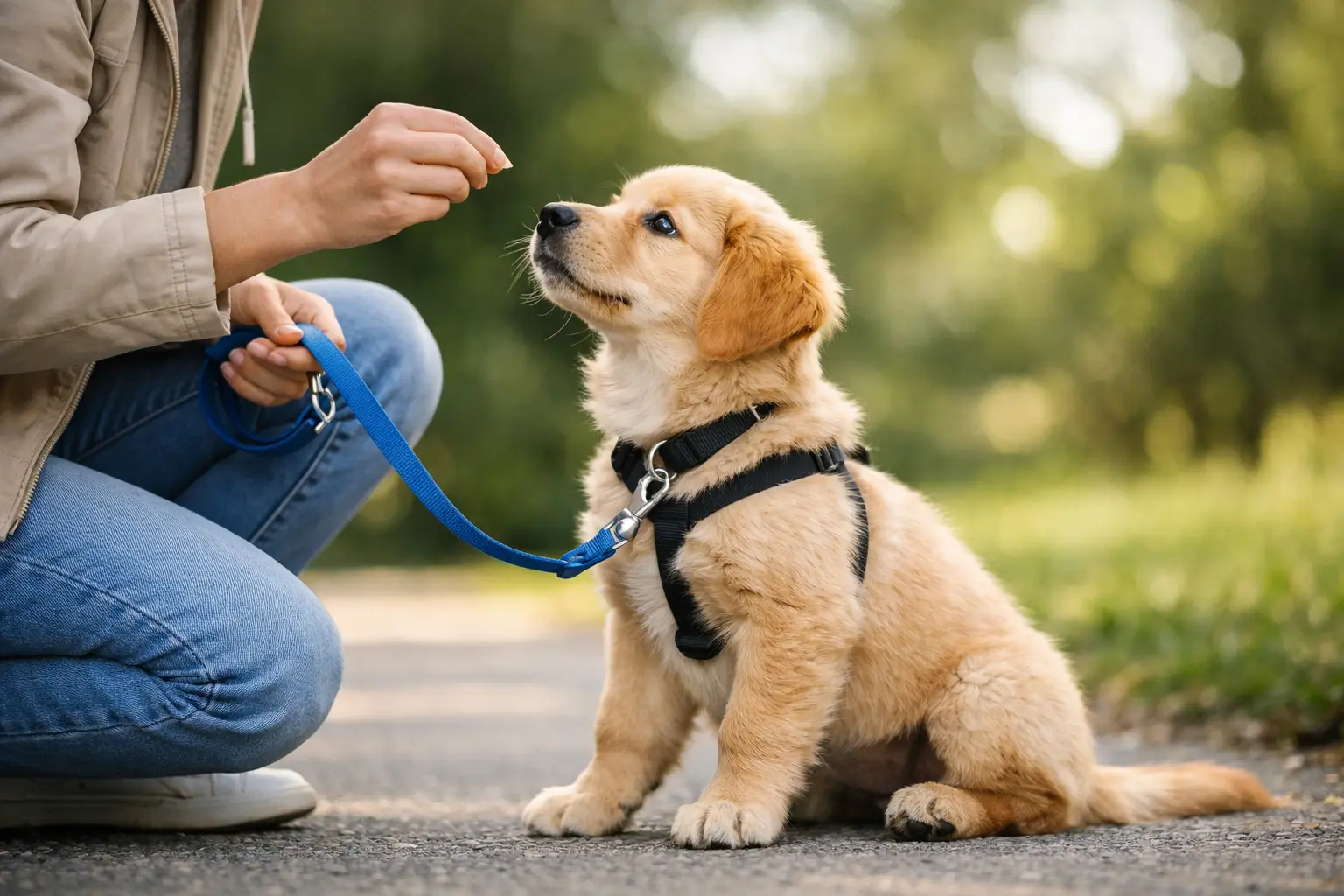
Before you ever head outside, let your puppy wear the collar or harness for a few minutes indoors while you offer treats, praise, and play. You want the gear to predict good things. Then clip on the leash and let them drag it for a short supervised session so the sensation becomes familiar.
Start indoors before you ask for a real walk
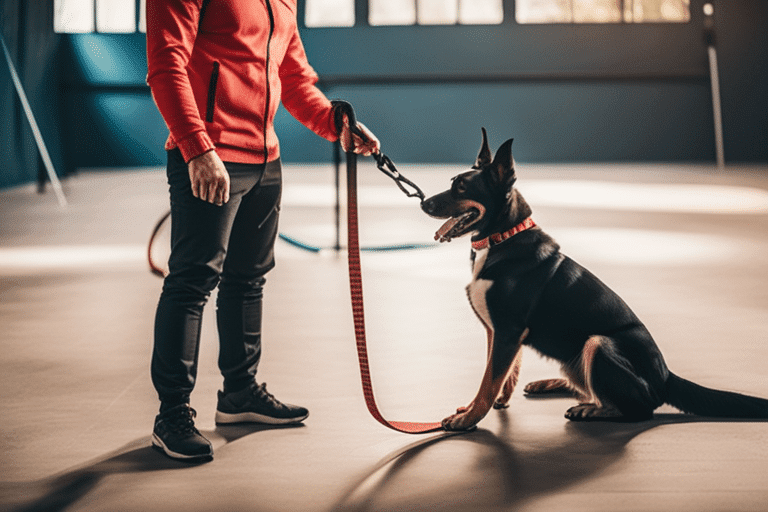
Indoor leash work feels almost too easy, which is exactly why it works. Inside, there are fewer distractions and fewer surprises. That gives your puppy a chance to learn the basic pattern: when I move with my person, good things happen.
Hold the leash loosely and take a few steps. The moment your puppy follows, mark it with a cheerful yes or a click and reward with a small treat. Then move again. At this stage, you are not asking for perfection. You are teaching connection.
Keep sessions short – about three to five minutes is plenty for many young puppies. A few mini sessions each day usually work better than one long practice. Puppies learn through repetition, but they also hit a wall quickly when they are tired, overstimulated, or hungry.
If your puppy bites the leash, resist the urge to wrestle it away. That often turns the leash into a toy. Instead, stop moving, make the leash boring, and redirect their mouth to a toy or ask for a simple cue like sit if they know it. Then reward and continue.
Reward the position you want
A lot of owners accidentally reward pulling by continuing to walk while the leash is tight. Puppies are quick studies. If lunging forward gets them closer to the smell, person, or patch of grass they want, they will keep doing it.
Try to reward your puppy when they are near your side or checking in with you. The exact side does not matter unless you want it to. What matters is consistency. Deliver treats low and close to your leg so your pup learns that being near you is the profitable place to be.
This does not mean your puppy must march in a formal heel on every walk. For most pet owners, the goal is a loose leash and a dog that can explore without dragging you. That is a more realistic standard, especially for babies.
Take it outside in tiny steps
Once your puppy can move comfortably with you indoors, practice in a quiet outdoor area like your yard, driveway, or a calm stretch of sidewalk. Expect progress to wobble here. Outside is where smells multiply, noises pop up, and your puppy suddenly remembers they have opinions.
Bring very good treats. What worked in the kitchen may not compete with a squirrel. Use distance to your advantage too. If your puppy is too distracted to take food or keeps hitting the end of the leash, the environment is probably too hard right now.
This is where patience pays off. Stand still when the leash tightens. The second your puppy turns back, softens the leash, or takes even one step toward you, reward. You are teaching that tension makes the walk pause and returning attention to you makes it move again.
What to do when your puppy stops walking
Some puppies pull. Others refuse to move at all. A frozen puppy is often dealing with uncertainty, not defiance. New textures, traffic sounds, trash cans, or simply being away from home can feel like a lot.
If your pup stops, avoid dragging them forward. Kneel down, speak lightly, and encourage them with a treat or happy movement. Sometimes walking a few steps backward gets a puppy to follow. If they are still worried, end the session and try again later in an easier setting. Confidence grows through manageable exposure, not force.
Common leash training problems and how to handle them
Pulling is the issue most people notice first, but it is rarely the only one. Puppies also mouth the leash, dart from side to side, jump at people, or get overexcited as soon as they see the harness. These are normal early-training wrinkles, and the fix is usually a mix of management and repetition.
For a puppy that surges ahead, stop every time the leash goes tight and reward when they return to a loose leash. You can also change direction before they hit full tension, which teaches them to pay attention to your movement. If walks become a constant battle, shorten them. Ten successful minutes beats thirty frustrating ones.
For a puppy that gets wild on leash, look at timing. Some pups walk best after a little play, when their edge is off. Others do better first thing in the morning before the neighborhood gets busy. It depends on your dog.
For a puppy that seems scared outdoors, socialization pace matters. According to the American Kennel Club, positive exposure during puppyhood helps dogs build confidence, but overwhelming experiences can backfire. Keep outings brief, upbeat, and far enough from stressful triggers that your puppy can still engage with you.
How to leash train a puppy safely in public
There is a practical side to leash training that goes beyond manners. Safe walks protect your puppy from traffic, loose dogs, toxic debris, and health risks tied to incomplete vaccinations.
If your puppy has not finished their vaccine series, ask your veterinarian where it is safe to practice. The American Veterinary Medical Association recommends working closely with your vet on preventive care and exposure decisions for young dogs. In many cases, you can still practice leash skills in low-risk areas or carry your puppy in higher-traffic places for social exposure.
Watch the temperature too. Hot pavement, cold rain, and long outings can sour a puppy on walks before training has a chance to click. Young dogs tire faster than many people expect.
Keep sessions realistic
A puppy does not need a long daily march to learn leash manners. In fact, long walks often create more mistakes than learning. Think in short training moments rather than mileage.
You are looking for a pattern your puppy can repeat successfully. A few steps on a loose leash, a check-in, a reward, and a calm reset are enough to build the habit. The ASPCA emphasizes positive reinforcement because dogs repeat behaviors that are rewarded. That principle matters far more than trying to correct every wrong move.
When to ask for extra help
Some leash issues are straightforward. Others need a closer look. If your puppy screams in the harness, panics outdoors, shuts down completely, or shows intense fear around normal walking triggers, it is worth talking with your veterinarian or a qualified positive-reinforcement trainer. Pain, poor gear fit, and anxiety can all look like training problems.
Support early is often easier than trying to undo a strong habit later. That is especially true for large-breed puppies, since a cute little puller can become a full-body workout by adolescence.
A well-leash-trained puppy is not born polite. They get there one short session at a time, with clear feedback, easy wins, and a person who remembers that progress is rarely linear. Stay patient, keep your expectations age-appropriate, and let each walk teach your puppy that the world feels better when the two of you move through it together.